
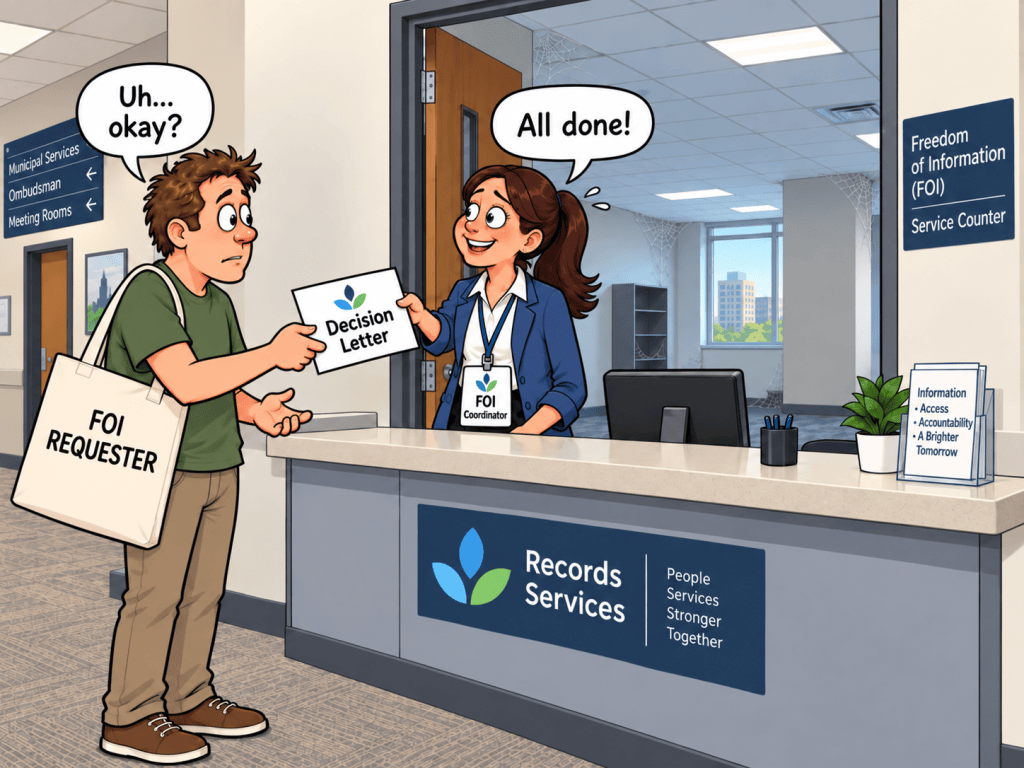
The Information and Privacy Commissioner of Ontario (IPCO) recently issued an important notice about processing access requests.
IPCO has been seeing an increase in cases where institutions have missed the decision letter deadline and then attempted to address the resulting deemed refusal by issuing a final access decision — sometimes charging a final fee — before reviewing the records responsive to the request, and in some cases, even before the search for such records has been completed.
IPCO’s message is clear: a final access decision cannot properly be issued until the institution has completed a reasonable search and reviewed the responsive records.
Under FIPPA and MFIPPA, a “deemed refusal” arises when an institution fails to issue its access decision within the statutory deadline. Once that deadline passes without a valid decision, the institution is deemed to have refused access to the requested records. The requestor may then appeal the deemed refusal to the IPCO, a situation most institutions endeavour to avoid.
In recent appeals before the IPCO Tribunal, the IPCO discovered some institutions have attempted to remedy a deemed refusal by issuing a final access decision and charging a final fee:
- without providing a fee estimate, in cases where one is required;
- without reviewing the responsive records; and in some cases,
- without completing searches for the responsive records.
IPCO’s telltale sign this practice has been occurring is these institutions are typically unable to provide IPCO with copies of the responsive records upon request.
It is easy to see why an institution might be tempted to take this approach. Once a request has fallen into deemed refusal, the institution may be facing negative reporting, the prospect of an appeal, and pressure to bring the file to a conclusion. In that situation, an institution might be tempted to issue a final decision based on what it expects the responsive records will contain, rather than waiting until the search and review have actually been completed. For example, it may believe that few or no exemptions are likely to apply, or that it already has a reasonable sense of which exemptions would be relevant. Similarly, an institution might be tempted to charge a low final fee rather than completing a formal fee assessment, particularly where the administrative cost of an appeal could far exceed the amount recoverable from the requestor under Ontario’s FOI legislation.
Nevertheless, per the IPCO, a final access decision presupposes that the institution has already:
- actually completed a reasonable search and identified the responsive records;
- reviewed those records; and
- determined whether access will be granted in whole or in part.
In other words, an institution cannot properly issue a “final” decision simply to bring a deemed-refusal situation to an end. A final decision is intended to communicate to the requestor that the necessary search and review work has actually been completed and that the institution is in a position to make an informed decision about access. Issuing a decision before that work is finished risks misleading the requestor as to the status of the file and increases the likelihood of further problems if unexpected records are later located or the institution’s access decision changes once the records are actually reviewed.
IPCO’s Advice for Avoiding this Situation
The IPCO notes recent amendments to FIPPA and MFIPPA give institutions considerably more flexibility for managing difficult requests, including:
- a 45-business-day initial response period;
- the ability to issue second time extensions in certain cases; and
- staged access plans and a process that allows the institution to amend that plan in coordination with the requestor.
However, per IPCO, these tools can only be used before the applicable statutory deadline expires.
IPCO expressly states that once an institution is in a deemed refusal situation, it cannot subsequently use a time extension or staged access plan to retroactively cure the deemed refusal:
While these measures provide institutions with greater flexibility when responding to access requests, they must nonetheless be used within the applicable statutory time limits. Once an institution is in a deemed refusal, it cannot subsequently rely on these tools to fix the deemed refusal after the fact. The only way to resolve a deemed refusal appeal is to issue a final access decision where all responsive records have been identified and reviewed. This is why it is important for institutions to avoid situations of deemed refusals in the first place, by making use of the flexible tools now available to them within the statutory timelines given.
While this interpretation may seem strict, institutions should be aware it reflects the approach the IPCO Tribunal can be expected to apply.
The Practical Takeaway
In issuing this notice, IPCO is emphasizing the importance of identifying and dealing with potentially difficult requests before the deadline arrives.
If it becomes apparent that searches, consultations or record review cannot realistically be completed within the ordinary response period, FOI professionals should consider the tools available under FIPPA or MFIPPA while there is still time to use them.
What institutions must avoid is allowing the deadline to pass and then issuing a “final” decision before the underlying searches and record review are actually complete.
How FOI Assist can help
The FOI Assist Software calculates statutory deadlines using the current FIPPA and MFIPPA rules and supports all of the newest request-management tools introduced this year under Bill 97, including second time extensions and staged access plans.
FOI Assist keeps deadlines current and visible throughout the process, while built-in email reminders can help FOI professionals recognize early when additional time or a staged access approach may be warranted.
IPCO’s recent notice serves as a useful reminder that completing a request is about more than sending the final decision letter. Identifying responsive records, issuing fee estimates, and affected person notifications each have an important place in the FOI process. FOI Assist is designed to help institutions manage these steps, track applicable deadlines, and maintain a clear record of the work completed on each request.
IPCO’s full notice is available on its website: “Notice to Freedom of Information Coordinators and Chief Administrative Officers: Processing access requests and providing records to the IPC during appeals.”


Leave a Reply