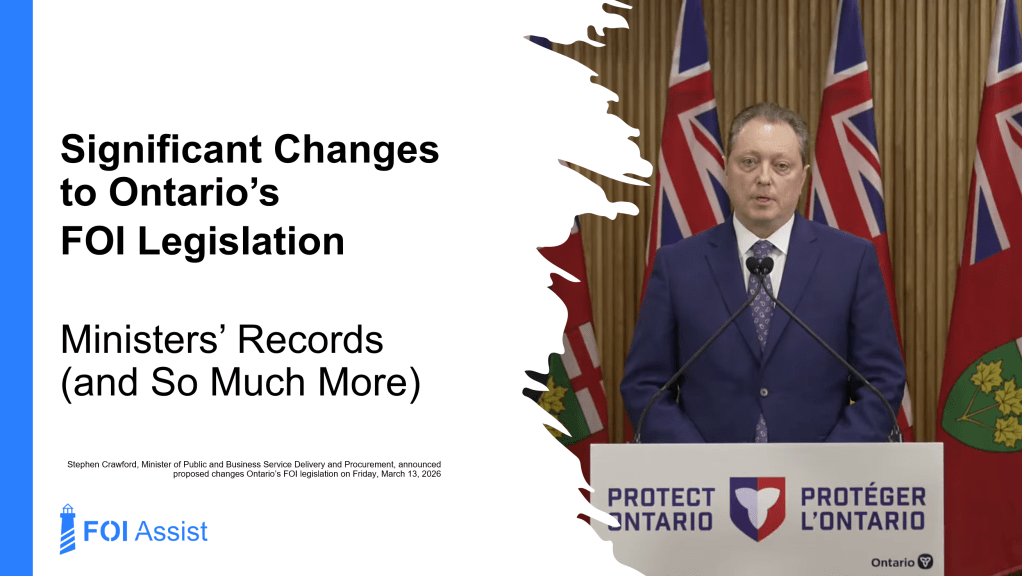
On April 28, 2026, FOI Assist presented the third seminar in the FOI Assist Seminar Series (2026): Significant Changes to Ontario’s Freedom of Information Legislation.
The session examined the major amendments to Ontario’s Freedom of Information laws introduced in Bill 97, the Plan to Protect Ontario Act (Budget Measures), 2026, which received Royal Assent on April 24, 2026.
The new legislation makes a wide range of changes to both FIPPA and MFIPPA, introducing new exclusions, new deadlines, new procedural tools, and, for municipal institutions, significant new privacy obligations.
Today’s seminar recap provides an update on the status of Bill 97 and a high-level overview of its amendments to Ontario’s FOI laws.
The slides from the seminar are available directly below for those who would like to review this material in more detail.
Status of the FOI Amendments
The proposed changes to Ontario’s FOI legislation were first announced on March 13, 2026.
Rather than being introduced as a stand-alone bill, the FOI amendments were incorporated into Ontario’s Budget Bill (Bill 97) and introduced for First Reading on March 26, 2026.
From there, the legislative process was fast-tracked, and it moved quickly:
- March 30, 2026 – Second Reading
- April 2, 2026 – Bill 97 passed Second Reading and was referred to committee
- April 21, 2026 – The government moved to discharge the bill from committee prior to any hearings or clause-by-clause review
- April 22, 2026 – Third Reading
- April 23, 2026 – Bill 97 passed Third Reading
- April 24, 2026 – Royal Assent received
Most of the FOI amendments summarized below are now due to come into force on July 1, 2026, unless specified otherwise.
Changes to the FOI Process
Adopting Business-Day Deadlines
One of the most significant operational changes is the move from calendar days to business days for most FOI timelines.
For example:
| Deadline | Previous | New |
|---|---|---|
| Decision letter | 30 days | 45 business days |
| Transfer/Forward requests | 15 days | 15 business days |
| Affected Person Response Deadline | 20 days (after AP notice) | 20 business days (after AP notice) |
| Period to Consider AP Reps | 10 days (after above) | 10 business days (after above) |
| Appeal period | 30 days | 30 business days |
In practical terms, the basic deadline for many requests (45 business days) will be more than twice as long as under the current system (30 calendar days).
Institutions will need to review their internal procedures, letter templates, and training materials to ensure that they understand and correctly apply the new deadlines.
Second Time Extensions
Under the amended legislation, institutions may now issue a second time extension in limited circumstances, including:
- with the consent of the requestor
- where the number of responsive records is significantly more than initially identified
- where certain unforeseeable circumstances arise: the unavailability of knowledgeable employees, or additional consultations becoming necessary
Staged Access Plans
Bill 97 introduces a new procedural tool known as a Staged Access Plan.
This allows institutions to divide large or complex requests into stages when responding to the request all at once would unreasonably interfere with the operations of the institution, or certain other circumstances apply.
A staged access plan must:
- divide the request into categories of records
- identify the areas of the institution to be searched
- set out a schedule for decisions and disclosures.
Requestors must respond to an institution’s staged access plan within 30 business days. Failure to respond may result in the request being deemed abandoned.
New Exclusions
Bill 97 introduces new exclusions for ministers and parliamentary assistants that have been the subject of significant media attention.
Ministers’ Records
FIPPA now excludes records that are:
- in the custody of a minister or their office, or
- under the control of a minister or their office,
unless the record is also in the custody of an institution.
A similar exclusion was also introduced for parliamentary assistants and their offices.
The new Ministers’ Records and Parliamentary Assistants exclusions are retroactive to January 1, 1988, when Ontario’s FOI regime first began.
Cyber Security Records
A new exclusion applies to certain records created under the Enhancing Digital Security and Trust Act, 2024, including:
- records identifying cybersecurity contact personnel
- cybersecurity assessments or evaluations
- certain records relating to software applications used by school boards
- records whose disclosure could reasonably compromise cybersecurity.
Privacy Obligations for MFIPPA Institutions
Several significant new privacy obligations for MFIPPA institutions will come into effect on January 1, 2027.
Mandatory Privacy Impact Assessments
Before collecting personal information, institutions will be required to prepare a written Privacy Impact Assessment (PIA), and the same PIA content requirements previously set out in FIPPA are now being added to MFIPPA.
Privacy Breach Reporting
MFIPPA institutions will also be required to:
- report certain privacy breaches to the Information and Privacy Commissioner of Ontario, and
- notify affected individuals if there is a real risk of significant harm.
Institutions must also maintain records of all privacy breaches and include this information in their annual report to the Commissioner.
Other Legislative Changes
Bill 97 introduces several other reforms, including:
- codifying the institution’s obligation to assist requestors in formulating valid requests
- removing the concept of Personal Information Banks from the legislation
- updating the definition of “record” to explicitly include data stored in digital or other electronic forms
- permitting Ontario Public Service employees to retain their email history when moving between positions
- amendments to data integration rules under FIPPA.
Key Takeaways
For the vast majority of Ontario FOI Professionals, the most significant implications of Bill 97 are its changes to the FOI process, rather than the controversial new exclusions.
In particular:
- Timelines are changing dramatically, shifting to a business-day system.
- Institutions are gaining new procedural tools such as staged access plans and second time extensions.
- Municipal institutions will face major new privacy compliance requirements beginning in 2027, such as the obligation to prepare PIAs when collecting personal information, and mandatory privacy breach reporting.
FOI professionals should begin preparing now by updating internal procedures, templates, and training ahead of the July 1, 2026 implementation date.
Bill 97 and the FOI Assist Software
The FOI Assist software is always kept up to date with the latest legislation, directives, and guidance governing Freedom of Information in Ontario.
FOI Assist is currently being updated to support the changes introduced by Bill 97, including:
- business-day deadline calculations
- updated decision timelines
- support for second time extensions
- staged access plans
- updated FOI correspondence reflecting the new legislative framework
With these updates, FOI Assist users will be able to continue processing requests confidently and in accordance with Ontario’s Freedom of Information legislation.
To learn more about the FOI Assist software, or to see how it can help your institution manage FOI requests efficiently and in compliance with FIPPA and MFIPPA, please contact FOI Assist to arrange a demonstration.


Leave a comment