
As of July 1, 2026, the Bill 97 amendments to Ontario’s Freedom of Information and Protection of Privacy Act (FIPPA) and Municipal Freedom of Information and Protection of Privacy Act (MFIPPA) introduce the use of “business days,” rather than calendar days, to calculate most Freedom of Information (FOI) deadlines.
One question that arises is how “holidays” are defined for the purpose of calculating these new deadlines.
What is a “business day”?
Section 2(5) of FIPPA and section 2(4) of MFIPPA (both as recently amended by Bill 97) provide:
a business day is any day that is not a Saturday or a holiday.
At first glance, this wording may seem incomplete because it does not mention Sundays. However, this is because Sundays are already included in the statutory definition of “holiday.”
Where is “holiday” defined?
Neither FIPPA nor MFIPPA defines the term “holiday.” Instead, as provincial legislation, both FIPPA and MFIPPA rely on the definition found in Ontario’s Legislation Act, 2006.
Section 88(2) of the Legislation Act, 2006 defines the following days as “holidays”:
- Sunday
- New Year’s Day
- Family Day
- Good Friday
- Easter Monday
- Victoria Day
- Canada Day
- Labour Day
- Thanksgiving Day
- Remembrance Day
- Christmas Day
- Boxing Day
- Any day fixed as a holiday by proclamation of the Governor General or the Lieutenant Governor.
Because every Sunday is defined as a “holiday” under the Legislation Act, 2006, Sundays are excluded when counting “business days” under FIPPA and MFIPPA.
Accordingly, the definition of “business day” under FIPPA and MFIPPA effectively means:
A “business day” is any day that is not a Saturday, a Sunday, or one of the statutory holidays defined by the Legislation Act, 2006.
What happens when a holiday falls on a weekend?
Section 88 of the Legislation Act, 2006 contains special rules dealing with statutory holidays that fall on weekends. Because FIPPA and MFIPPA rely on the Legislation Act’s definition of “holiday,” these rules also apply when calculating business-day deadlines for Freedom of Information purposes.
In particular:
- Every Sunday is a “holiday”, regardless of whether it is also another statutory holiday.
- If New Year’s Day (January 1) falls on a Sunday, then Monday, January 2 is also a “holiday.”
- If Canada Day (July 1) falls on a Sunday, Canada Day is deemed to fall on Monday, July 2.
- If Christmas Day (December 25) falls on Saturday, it is observed on Monday. If it falls on Sunday, it is observed on Tuesday, with Boxing Day (December 26) already observed on the Monday.
For example:
- If New Year’s Day falls on a Sunday, both Sunday, January 1 and Monday, January 2 are excluded from the calculation of “business days.”
- If Canada Day falls on a Sunday, Sunday is not a business day because every Sunday is a “holiday,” and Monday, July 2 is not a business day, because Canada Day is deemed to fall on that day.
- If Christmas Day falls on a Sunday, the immediately following Monday (Boxing Day) and Tuesday (substitute holiday) are both considered “holidays” under the Legislation Act, 2006 and therefore are not “business days.”
- However, under the Legislation Act, 2006, if Christmas Day falls on a Saturday, only the Monday is deemed a holiday, and no additional substitute holiday is provided for Boxing Day.
The Saturday Surprise
One interesting consequence of FIPPA and MFIPPA‘s reliance on the Legislation Act, 2006 is that no substitute holiday is created when New Year’s Day or Canada Day falls on Saturday, because Saturday is not itself defined as a “holiday” under the Act.
The result when Christmas Day falls on Saturday can be somewhat surprising as well.
Specifically:
- If New Year’s Day falls on Saturday, the Legislation Act, 2006 does not designate the following Monday as a holiday.
- Similarly, if Canada Day falls on Saturday, the Act does not designate the following Monday as a holiday.
- If Christmas Day falls on Saturday, only the Monday is deemed a holiday, and no special provision is made to observe an additional holiday for Boxing Day.
- Similarly, if Boxing Day falls on a Saturday, no special provision is made to observe it on a weekday.
The result is that the Legislation Act, 2006 does not consider some of the days on which provincial and municipal institutions in Ontario are regularly closed to be “holidays.”
What if the institution is closed?
Provincial and municipal government offices in Ontario are generally closed on the Monday immediately following New Year’s Day or Canada Day whenever either holiday falls on Saturday or on Sunday. Similarly, government offices generally observe two weekday Christmas closures every year, regardless of which day of the week Christmas Day falls on.
However, the Legislation Act, 2006 does not designate all of these closures as “holidays” and therefore these closures may be “business days” for the purposes of FIPPA and MFIPPA.
Fortunately, the Legislation Act, 2006 addresses the situation where an institution is closed on a day that is not a “holiday” under the Act. Section 89(2) provides:
89(2) Time limits for registering or filing documents or for doing anything else that expire on a day when the place for doing so is not open during its regular hours of business are extended to include the next day the place is open during its regular hours of business.
This implies that any deadline which lands on a day the institution is closed is automatically extended to the next day the office is open, even if the office closure is on a “business day” (as defined by the legislation).
Accordingly, institutions should calculate “business day” deadlines by excluding only Saturdays and the “holidays” defined in the Legislation Act, 2006—not every day on which the office happens to be closed. However, if the resulting deadline falls on a day the institution is closed, section 89(2) appears to extend the deadline until the next day the institution is open.
In other words, an institution’s office closures do not affect the calculation of “business days,” but they may still affect the date on which the deadline actually expires.
Business Day Calculator
If you would like to preview the new business day deadline calculations, you can try FOI Assist’s free Business Day Calculator.
The FOI Assist software calculates “business days” automatically
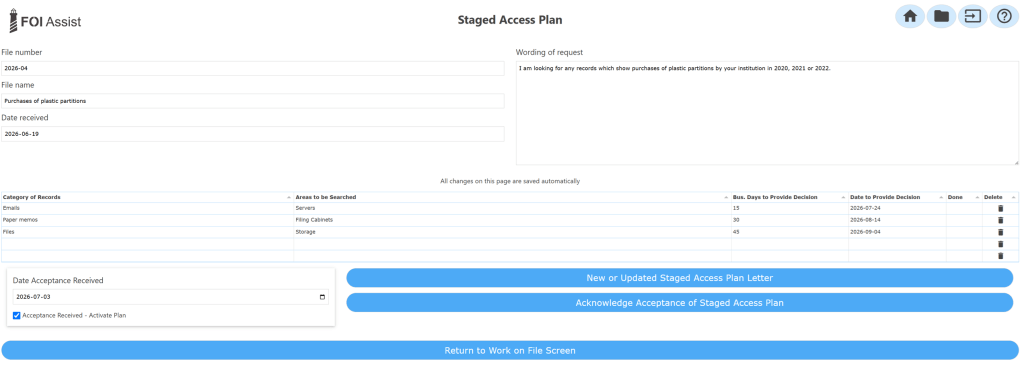
The FOI Assist software will automatically calculate deadlines in business days for requests received on or after July 1, 2026. The software also supports second time extensions and staged access plans, with appropriate deadline tracking and automatic creation of FOI correspondence in both official languages.
If you would like to see a demonstration of the FOI Assist software, please contact FOI Assist today.


Leave a comment