
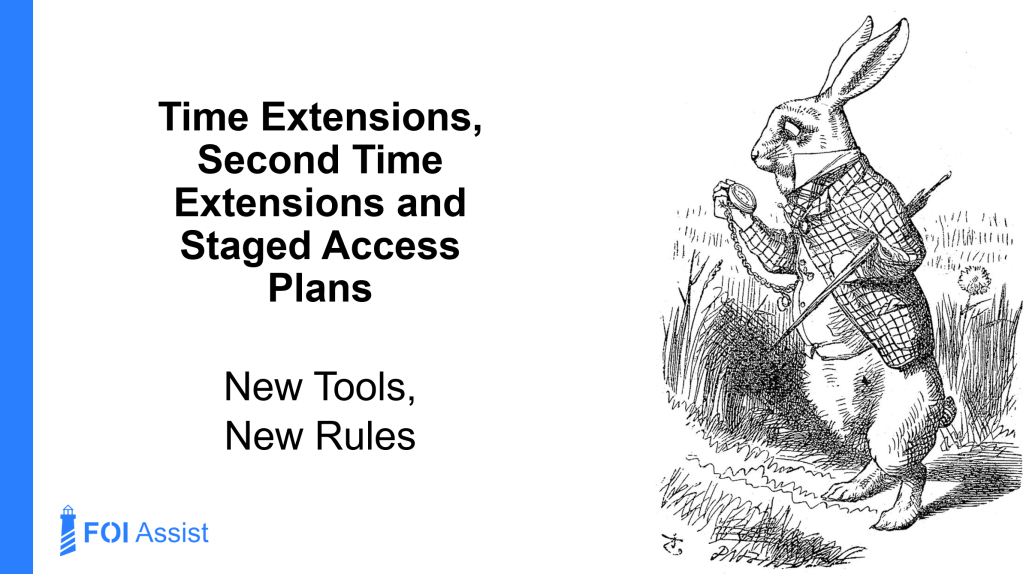
On July 14, 2026, FOI Assist hosted the fourth seminar in the FOI Assist Seminar Series (2026). Thank you to everyone who attended!
This seminar explained time extensions and some of the most significant procedural changes introduced by Bill 97, including Ontario’s new rules governing second time extensions and staged access plans under FIPPA and MFIPPA.
If you were unable to attend, or if you would like to revisit the material, the complete seminar slides are available below.
A New Framework for Managing Complex Requests
Bill 97 has introduced new tools to help institutions manage large and complex access requests.
In addition to extending the standard response period from 30 calendar days to 45 business days, the legislation now provides institutions with several new procedural tools designed to better manage requests that require substantial time and effort.
During the seminar, we explored how these new tools fit together, when each may be used, and some of the practical issues institutions should consider when deciding which approach is appropriate.
“First” Time Extensions Still Matter
Although Bill 97 introduced several new procedures, the rules governing traditional (“first”) time extensions remain largely unchanged.
Accordingly, pre-Bill 97 Information and Privacy Commissioner of Ontario (IPCO) appeal decisions interpreting the time extension framework under FIPPA and MFIPPA continue to serve as valuable guidance.
During the seminar, we examined both recent and historical IPCO decisions. One recurring theme emerged: large volumes of records alone are generally not enough to justify a lengthy time extension.
In the case of a time extension appeal, institutions should be prepared to explain:
- why meeting the statutory deadline would unreasonably interfere with the institution’s operations
- what work has already been completed and what work remains outstanding
- the resources that have been devoted to processing the request, and
- why the length of the requested time extension is reasonable in the circumstances.
We also discussed an important reality about time extension appeals: by the time many IPCO appeal decisions are issued, it’s common for most or all of the disputed time extension to have already elapsed. This leads to some interesting questions about the practical availability of time extension remedies through the appeal process.
Second Time Extensions
One of Bill 97’s most important procedural changes is the express authorization for second time extensions.
Previously, Ontario’s FOI legislation did not expressly address whether more than one time extension could be issued. (IPCO and FOI Manual guidance generally limited institutions to a single extension, however the legislation itself was silent.)
Beginning July 1, 2026, the legislation now explicitly permits one additional extension, but only in limited circumstances, including:
- where the requester consents;
- where substantially more responsive records are discovered than originally anticipated;
- where previously unforeseen staffing issues arise; or
- where additional consultations become necessary that could not reasonably have been anticipated earlier.
Because these provisions are so new, there are not yet any IPCO decisions interpreting them. The seminar explored each of these new statutory grounds and discussed practical questions that institutions are likely to face when considering a second time extension.
Staged Access Plans
Perhaps the most innovative feature introduced by Bill 97 is the Staged Access Plan.
A staged access plan is an entirely different statutory process from a time extension.
Rather than simply extending the deadline, the institution proposes a structured plan that divides the request into categories of records, establishes a schedule for processing and disclosure, and requires the requester to respond by accepting the plan, proposing amendments, or modifying their request.
Importantly, the statutory clock pauses while the requester considers the proposed plan.
This creates opportunities for meaningful dialogue about timelines and disclosure that traditional time extensions do not provide.
During the seminar, we walked through:
- when a staged access plan may be used;
- how the statutory process operates;
- the requester’s available responses;
- how amendments to the plan work; and
- practical drafting techniques for producing clear and workable staged access plans.
Looking Ahead
We will continue monitoring these developments and sharing updates through future seminars and articles here on the FOI Assist Knowledge Base.
Thank you again to everyone who attended Seminar #4.
If you have any questions or comments about the presentation, feel free to leave a comment below or to contact me directly.
I look forward to seeing you at the next seminar in the FOI Assist Seminar Series (2026). Details and registration information will be announced soon and emailed to all FOI Assist Knowledge Base subscribers.


Leave a comment