

In Ontario, the Freedom of Information and Protection of Privacy Act (FIPPA) and the Municipal Freedom of Information and Protection of Privacy Act (MFIPPA) allow requestors to make requests for “continuing access” to records held by an institution. The requestor’s right to make such requests is established in section 24(3) of FIPPA and section 17(3) of MFIPPA.
To make a continuing access request, a requestor will typically state they are seeking ongoing access to records matching a specific description which are expected to be created or updated in the future. The requestor may specify a time period of interest of up to two years, and may propose a schedule or frequency for receiving updates, such as monthly, quarterly, or annually.
Examples of records suitable for continuing access requests include:
- Minutes of recurring meetings (assuming they aren’t already being made publicly available)
- Current and future invoices from a specific vendor
- Correspondence related to a specific topic, or from a specific individual
- Proposals received by an institution in response to market solicitations
- Any regularly issued reports
- Any regularly updated records
Institutions should process continuing access requests in a fashion similar to regular requests. When a continuing access request is granted, the institution must provide the requestor with a schedule indicating the dates within the specified period of interest on which the request will be deemed to have been received again, along with an explanation as to why those specific dates were chosen. (FIPPA s.24(4)(a) and MFIPPA s.17(4)(a))
The Information and Privacy Commissioner of Ontario (IPCO) has made it clear that the schedule set by the institution must be “reasonable” (see Order P-107). The institution should assess how frequently the requested record(s) are likely to be updated in the future, and give careful consideration to any suggested schedule from the requestor. The schedule the institution provides to the requestor must include a notice that the requestor has the right to appeal the proposed schedule to IPCO (see FIPPA s.24(4)(b) and MFIPPA s.17(4)(b)).
Once the schedule has been established, the institution is expected to process future continuing requests as if they had arrived in accordance with the schedule as separate requests.
For example, if an institution receives a continuing access request on May 1, 2025, and decides on a “quarterly” schedule, it should provide an initial decision on the release of the records along with a copy of the written schedule to the requestor by May 31, 2025, i.e., thirty days after receiving the original request (subject to time extensions or other factors that may affect the deadline). The next quarterly request would be processed as though it was received on August 1, 2025 (three months later), with its own decision deadline of August 31, 2025. If the requestor’s stated period of interest was one year, the third and fourth requests would be deemed received by the institution on November 1, 2025 and February 1, 2026, respectively. In this situation, the institution may want to clarify with the requestor whether they would be interested in a fifth (final) request on May 1, 2026, which will affect the fees charged and the records provided to the requestor.
Requestors must pay a separate $5.00 application fee for each scheduled request. As the FOI Manual notes:
In practical terms, the original request is brought forward on each of the dates listed in the schedule and processed as if it were made on that day. The $5.00 application fee is required for each of the schedule dates. For convenience, it is advisable for institutions to request payment for application fees in a lump sum. For example, the institution may request $25.00 for five requests. Requesters may also pay individual $5.00 application fees according to the schedule if that is their preferred option.
Each time the request is scheduled to begin, the request needs to be reviewed and an access decision needs to be made. An institution cannot rely on its first decision for subsequent requests in the schedule. As a result, different requests under a single continuing access request may have different decisions on access, depending on the responsive records in each request and what exemptions or exclusions may apply to the records.”
Not Applicable to Denied Records
If an institution fully denies access to the requested records initially, it has no obligation to proceed with requests for continuing access based on the original request. This stems from the statutory language: “When a request that is to continue to have effect is granted, the institution shall provide the applicant with a schedule…” (see FIPPA s.24(4)(a) and MFIPPA s.17(4)(a)), and has been confirmed by IPCO decisions (e.g., Order P-82).
However, if the initial continuing access request is fully granted or even partially granted, this does trigger the obligation to issue a schedule and to process the continuing requests (see Order PO-2730).
If a requestor’s initial request is fully denied, this does not preclude them from making standalone requests for updated versions of the same records at a later date. (That said, if such requests become excessive or repetitive to the point of being an abuse of the right of access, the institution may wish to consider whether they meet the threshold for being deemed frivolous or vexatious.)
Not Limited to Records Produced in Series
Earlier IPCO decisions suggested continued access was suitable only for regularly produced or updated records. However, recent decisions clarify that continuing access requests need not be limited to such records.
For example, in Order PO-4463, Adjudicator Justine Wai ordered the Ministry of Public and Business Service Delivery to grant a request for continued access to “complete and up-to-date business contact information” for the named chairs of the boards of governors of two Ontario educational institutions, noting that “the right to request continuing access should be interpreted broadly, and not restricted to records produced in series.”
When Future Records Are Unlikely
If it is “impossible or highly unlikely that further responsive records would come into being during the continuing access period”, then the institution may refuse the continuing access request, or issue a schedule with very few dates on it (per Order PO-2730).
Applicable to General Records Only?
Although the FOI Manual states that the right to make a request for continued access to records applies to general records only (i.e., not to personal information), it cites no authority for this proposition. (See FOI Manual, Chapter 6, “Requests for Continued Access”.) The access procedure language of the statutes themselves (see FIPPA s.24 and MFIPPA s.17) does not appear to set out any such limitation, and a brief search of IPCO decisions revealed no support for it either. Institutions should therefore ensure they cautiously evaluate and research any decision to refuse continued access to records solely because they relate to the personal information of the requestor.
The “Soon to be Published” Exemption
Institutions may receive requests for “early access” to records on a continued basis from requestors who are eager to see the results of surveys, inspections, meeting minutes or other reports before such records are made available to the general public. In such cases, institutions may find it helpful to employ the “Publicly Available Information” exemption (sometimes referred to as the “Information Soon to be Published” exemption) found in FIPPA s.22 / MFIPPA s.15, which allows institutions to refuse to disclose records that they reasonably believe will be published within ninety days or such further time period as may be necessary. (For more information on this exemption, see my earlier article, Alternative Fee Systems for Publicly Available Information.)
Conclusion
Continuing access requests provide an effective mechanism for requestors to remain informed about regularly updated information without repeatedly filing separate requests. Institutions must approach scheduling and decision-making carefully, adhering to statutory requirements and IPCO guidance to ensure fairness and compliance.
The FOI Assist Software
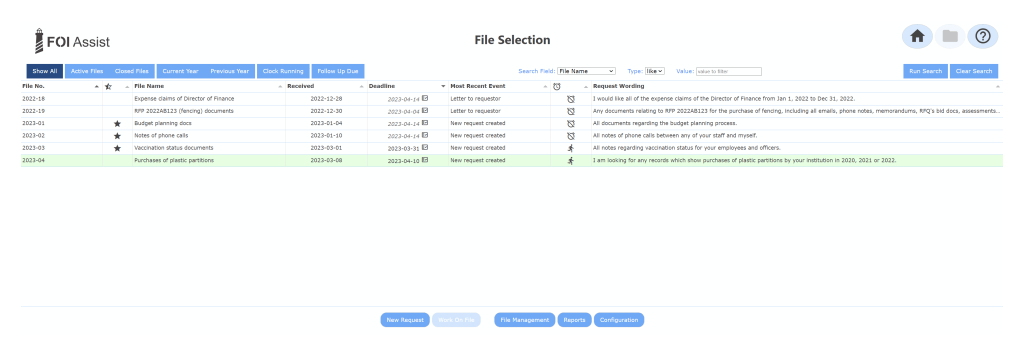
The FOI Assist software significantly simplifies managing access requests. Designed specifically for Ontario’s provincial and municipal institutions, FOI Assist streamlines the entire FOI process, offering robust scheduling features, automated reminders, fee tracking, and built-in compliance with IPCO directives. Consider implementing FOI Assist to enhance efficiency, compliance, and accuracy in managing your institution’s continuing access obligations.
For more information, contact FOI Assist today.
 FOI Assist Knowledge Base
Leave a comment