
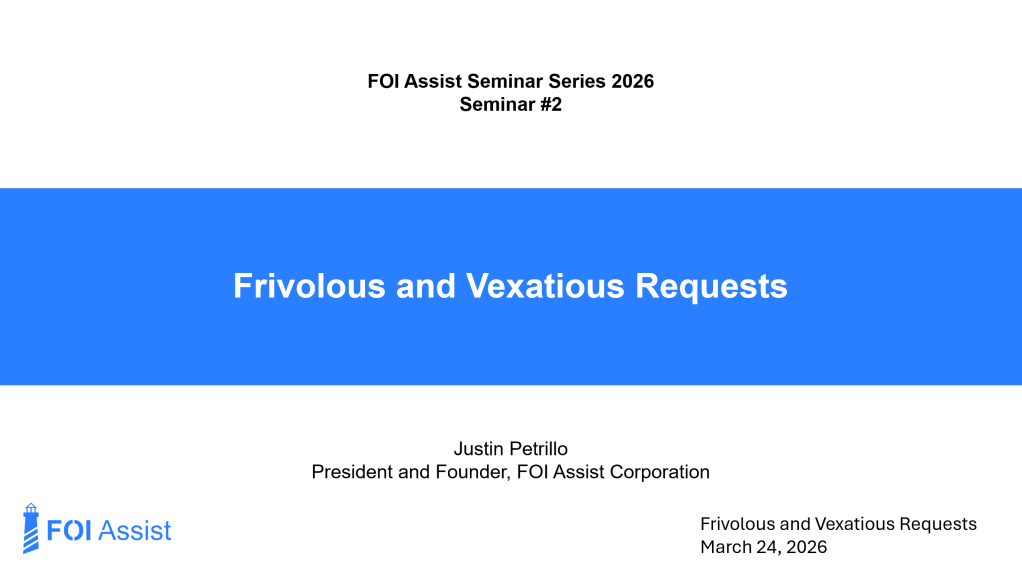
On March 24, 2026, FOI Assist hosted the second installment of the FOI Assist Seminar Series (2026) — and it was another excellent discussion.
The topic was Frivolous and Vexatious Requests. The session brought together FOI professionals from across Ontario for a practical examination of one of the most sensitive and sometimes misunderstood provisions in Ontario’s freedom of information legislation.
We explored when access requests cross the line from legitimate use of the access to information system into an abuse of the process, and how institutions can respond effectively and in a manner compliant with legislation.
For those who were able to attend, thank you for joining us. For those who couldn’t make it, I’m pleased to share the seminar slides and a summary of the key takeaways below.
Identifying Frivolous and Vexatious Requests
Ontario’s access legislation begins with a strong statement of the public’s right of access to government records. However, the legislation also recognizes that the access system can occasionally be abused.
For this reason, FIPPA s.10(1)(b) and MFIPPA s.4(1)(b) state that there is no right of access where the head of an institution is of the opinion, on reasonable grounds, that the request is frivolous or vexatious.
This provision exists to protect institutions from requests that are not genuinely aimed at obtaining information, but instead may seek to burden the system, harass staff, or interfere with institutional operations.
At the same time, the threshold for deeming a request frivolous or vexatious is deliberately high. Institutions must carefully apply the statutory framework set out in the general regulations under each Act.
The Four Ways a Request Can Be Frivolous or Vexatious
Section 5.1 of the general regulations under FIPPA and MFIPPA sets out four circumstances in which a request may be declared frivolous or vexatious.
These fall into two broad categories:
Pattern of Conduct
First, institutions may consider whether the requester’s pattern of conduct:
- amounts to an abuse of the right of access, or
- would interfere with the operations of the institution.
In these cases, the focus is not on a single request, but on the overall pattern of behaviour. Information and Privacy Commissioner of Ontario (IPCO) decisions emphasize that institutions should consider the cumulative nature and effect of the requester’s conduct.
For example, a requester may submit numerous overlapping or repetitive requests, or submit a large number of detailed requests within a short period of time. Even requests that might be reasonable individually can become problematic when considered together.
The Request Itself
The regulations also allow institutions to consider a single request itself, even in the absence of a pattern of conduct.
An individual request may be considered frivolous or vexatious if it was made:
- in bad faith, or
- for a purpose other than to obtain access to records.
IPCO has emphasized that “bad faith” is a high bar and should not be assumed lightly. Institutions should remember that requesters may seek records for many legitimate purposes — including publishing the information obtained, pursuing litigation, filing complaints, or challenging government decisions. Legitimate goals such as these do not make a request frivolous or vexatious.
However, if a request is submitted merely for amusement, or for some purpose other than obtaining access to records — for example, to make staff work harder, to annoy or inconvenience the institution, or simply to test the system — this may indicate that the request was made for a purpose other than obtaining access to records.
Notice Requirements
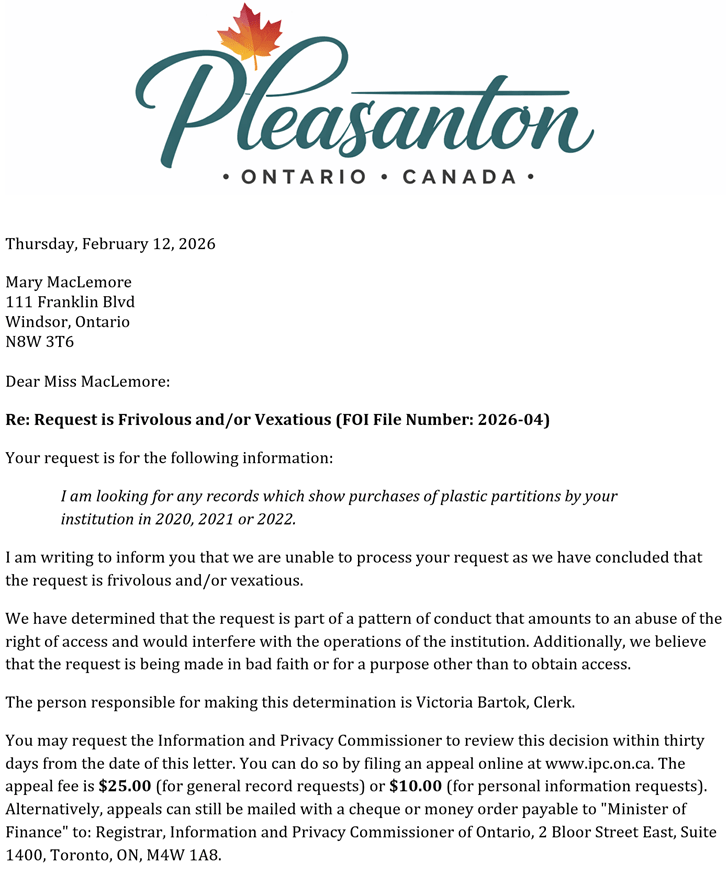
If an institution determines that a request is frivolous or vexatious, it must provide written notice to the requester explaining the determination and informing them of their right to appeal to the Information and Privacy Commissioner of Ontario (IPCO).
Careful drafting of these notices is important. IPCO decisions have shown that defective correspondence can undermine an institution’s position.
Institutions should also maintain clear documentation of the requester’s past requests and interactions with the institution in case the determination is appealed.
Recent IPCO Decisions
The seminar also reviewed recent IPCO decisions MO-4760 and MO-4761 (City of Brantford, February 6, 2026).
In those cases, IPCO found that a requester and his father were acting in concert to burden the city with frivolous or vexatious requests. As a result, IPCO imposed conditions limiting the requester (the son) to one active request and one active appeal at any given time.
These recent decisions offer a useful starting point for any institution considering declaring a request to be frivolous or vexatious.
Looking Ahead
Thank you to everyone who attended and helped make this second seminar such a thoughtful and engaging discussion.
Details about the next session in the FOI Assist Seminar Series (2026) will be announced soon through the FOI Assist Knowledge Base. If you enjoyed this seminar, we hope you’ll join us again — and if you missed this session, we would be delighted to have you participate in a future one.
Please make sure to subscribe to the FOI Assist Knowledge Base to receive announcements, resources, and updates about upcoming seminars.
The FOI Assist Software
With the FOI Assist software, Ontario’s provincial and municipal institutions can process and respond to Freedom of Information requests quickly, easily, and in full compliance with applicable legislation and guidance — including frivolous and vexatious requests.
To learn more, book a demonstration today.
 FOI Assist Knowledge Base
Leave a comment