
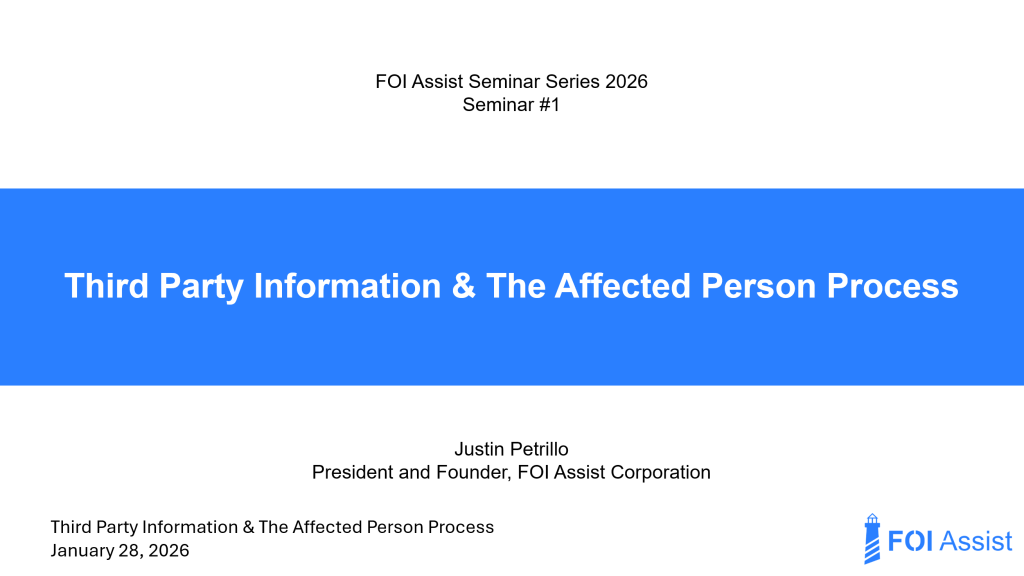
On January 28, 2026, FOI Assist hosted the very first session of the FOI Assist Seminar Series (2026) — and what a great start it was.
The inaugural seminar, “Third Party Information & The Affected Person Process,” was nearly at capacity and brought together FOI professionals from across Ontario and beyond for an in-depth, practical discussion of one of the most challenging areas of FOI practice.
The feedback from attendees was overwhelmingly positive, with many participants noting that the session helped clarify both the legal test for the Third Party Information exemption and the real-world mechanics of running a compliant Affected Person Process.
For those who were able to attend, thank you for joining us. For those who couldn’t make it, I’m pleased to share the seminar slides and a summary of the key takeaways below.
Why The Exemption Matters
The Third Party Information exemption (MFIPPA s.10 / FIPPA s.17) is one of the most commonly used — and most complex — exemptions in Ontario FOI law. It frequently arises in contexts such as:
- procurement and bidding records
- vendor submissions
- financial or technical reports
- contracts and proposals
The exemption is mandatory, meaning that if it applies, the institution must refuse disclosure (unless the public interest override applies or the third party consents).
Applying this exemption properly also requires following a specific procedure: the Affected Person Process. As we discussed in the seminar, these are really two sides of the same coin — the exemption is the legal test, and the Affected Person Process is the mechanism for using it correctly.
The Core Legal Test
To rely on the Third Party Information exemption, all three of the following must be true:
- The record contains protected information (commercial, financial, technical, etc.);
- The information was supplied in confidence by a third party; and
- Disclosure could reasonably be expected to cause one of the listed harms.
If any element is missing, the exemption does not apply. A key takeaway from the session was that most negotiated contracts are not considered “supplied,” a point that can surprise practitioners.
The Affected Person Process – In Plain Language
If an institution is considering disclosing records which may contain Third Party Information or Personal Information, the institution must notify affected persons and give them an opportunity to make representations.
The basic steps are:
- Identify potentially affected records
- Issue Affected Person Notices
- Allow 20 days for representations
- Make disclosure decisions within the next 10 days
- Issue decision letters
- Hold the records for 30 days to preserve appeal rights
- Disclose (if no appeal is filed)
We also reviewed practical tips for drafting notices, tracking deadlines, and avoiding common mistakes such as using outdated appeal language or disclosing records too early.
I encourage you to review the slide deck posted above for additional information on the Third Party Exemption and the Affected Person Process, as well as my earlier FOI Assist Knowledge Base article: The Affected Person Process.
Looking Ahead
Thank you to everyone who attended and helped make our first seminar such a success.
Details about the next session will be announced soon through the FOI Assist Knowledge Base. If you enjoyed this seminar, we hope you’ll join us again—and if you missed this first session, we’d still be delighted to have you join us at the next one. Please make sure to subscribe to the FOI Assist Knowledge Base to receive future announcements and updates.
 FOI Assist Knowledge Base
Leave a comment