An article published this morning in The Varsity, University of Toronto’s student newspaper, announced the release of University of Toronto’s Sunlight Project, describing it as “the most comprehensive Canadian database of Freedom of Information requests.”
As explained in the article:
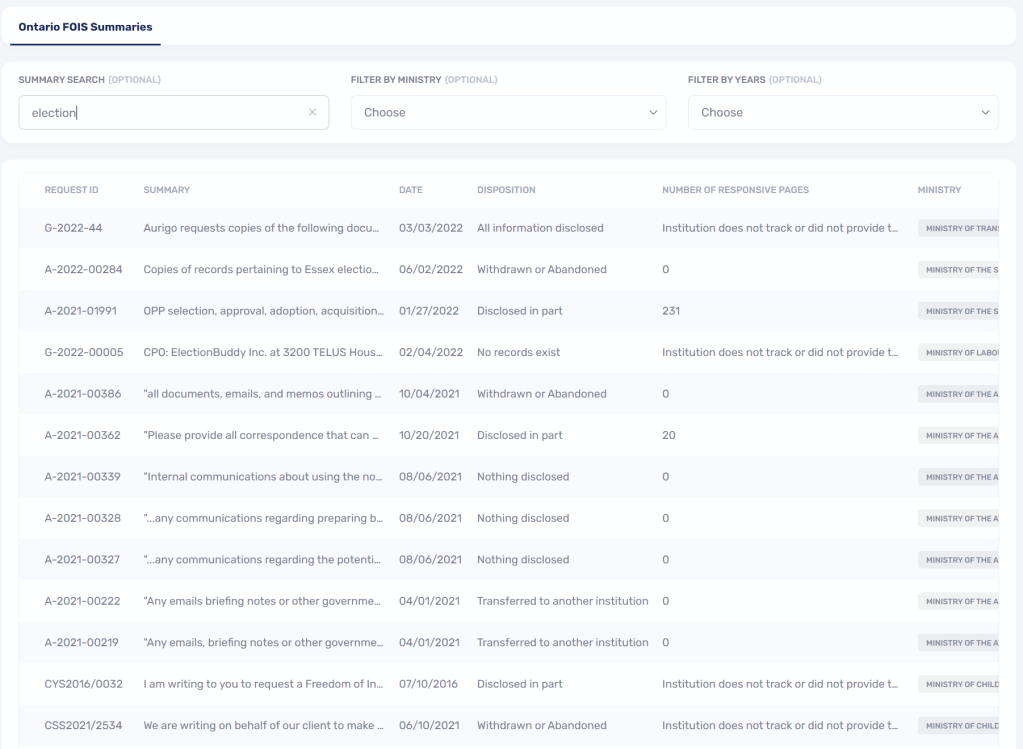
The Sunlight Project is a free-to-the-public database that consolidates the details of over 75,000 freedom of information (FOI) requests individuals have made to the offices of the Ontario government’s 28 legislative assembly ministers since 2014. The database provides researchers with basic summaries of whether these requests could uncover useful information and helps users figure out how to access previously uncovered data via a simple keyword search.
Carly Campbell, “U of T Sunlight Project: The most comprehensive Canadian database of Freedom of Information requests,” The Varsity, March, 25, 2024
Freedom of information requests are written records, which means the details of each request are themselves subject to disclosure in response to a future freedom of information request. The Sunlight Project appears to have used this knowledge to obtain lists of every freedom of information request received by each of Ontario’s ministries and legislative offices (including Archives Ontario, the Cabinet Office, the Premier’s Office, and the Treasury Board Secretariat). The Sunlight Project then assembled the results into a convenient online database which members of the public can use both to see what types of requests have been made and to easily request the same information themselves.
The Sunlight Project includes a helpful video tutorial and I personally found the interface inviting and easy to use.
Notably, the site’s interface makes it easy to copy the wording of the request and then to re-submit the same request via the Province of Ontario’s online freedom of information request submission page. Resubmitting a previous completed request has several advantages over submitting a new request:
- It can be easier to simply choose request wording from a list rather than trying to develop new request wording “from scratch”
- You can use the database to check whether a particular request was answered in full, partially, or whether no records were provided in response to a request before submitting your application
- The time and costs involved in processing the freedom of information request should be significantly reduced, since in most cases, the institution should have a copy of the records disclosed already on file. Records which might have cost thousands to locate, retrieve and prepare in the first instance might cost only tens of dollars to photocopy in response to a later request for the same records. Institutions should also find it preferable to simply repurpose disclosure they have already prepared, rather than have to search, review and prepare records anew.
Opportunities for Expansion
Ontario Only
The title of the Varsity article describes the Sunlight Project as “The most comprehensive Canadian database of Freedom of Information requests.” However, it’s important to note that the database currently includes data only for FOI requests made in Ontario.
Types of Institutions Covered
Specifically, the database contains only requests made under the Freedom of Information and Protection of Privacy Act (FIPPA) to the Province of Ontario’s ministries and legislative offices. Requests made to other types of provincial institutions, such as colleges and universities, hospitals, agencies, boards and commissions, as well as provincial Crown corporations such as the LCBO, GO Transit, Metrolinx and TVO are not currently included, although they certainly could be added at some point in the future. Likewise, municipal organizations which fall under the Municipal Freedom of Information and Protection of Privacy Act (MFIPPA) are also excluded, at least for now.
Date Range
It appears the earliest requests in the database date back to 2014, or roughly ten years ago.
Responses to Requests
The database does not contain any of the records that the institutions disclosed in response to the requests. Requests for such records must be made directly to the institution who originally provided them. However, as described above, the Sunlight Project makes it easy to re-submit a request to the original institution, and in most cases, requestors can expect a re-submitted request to be processed quickly and at a low cost. The Sunlight Project database also generally includes the disposition of the request (e.g., whether the requested records were fully disclosed, disclosed in part, or withheld) and sometimes even reveals the number of pages disclosed.
Personal Information Requests
Finally, the database appears to include only requests for general information, and does not contain the details of requests for access to or correction of personal information. That said, I would more accurately describe this last item as a “sensible limitation” rather than an “opportunity for expansion.” The details of a request for personal information would not generally be disclosable to anyone other than the person to whom the personal information relates, as the wording of the request itself would usually be considered personal information in its own right and therefore protected under the personal information exemptions in FIPPA and MFIPPA.
Conclusion
I encourage everyone to check out the Sunlight Project and to try some searches for yourself. It appears to be an extremely worthwhile contribution to Ontario’s democratic process. I hope to see it thrive and expand to cover more jurisdictions and a wider variety of government institutions.
The FOI Assist Software
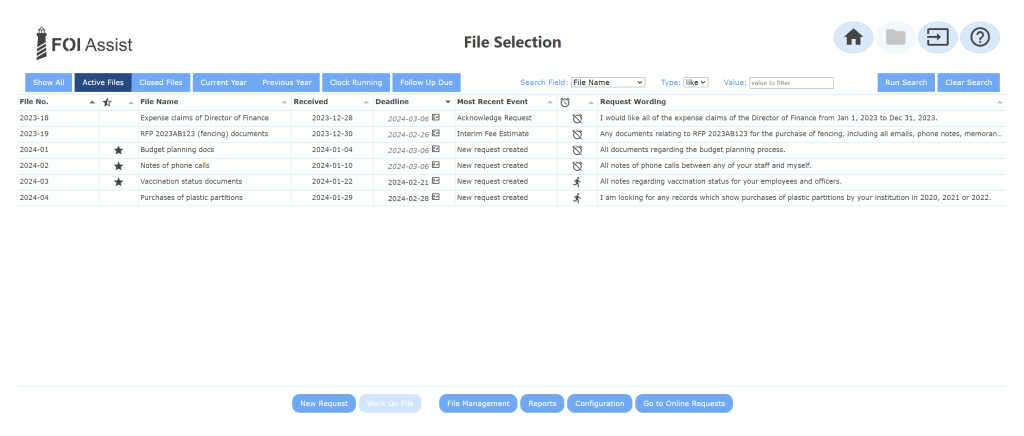
If you have a friend or colleague who processes Freedom of Information requests, please encourage them to check out the FOI Assist software. The FOI Assist software makes it easy to track, manage and respond to Freedom of Information requests in full compliance with FIPPA and MFIPPA, and allows instituitions to easily accept FOI requests online as well.
 FOI Assist Knowledge Base
Leave a comment