
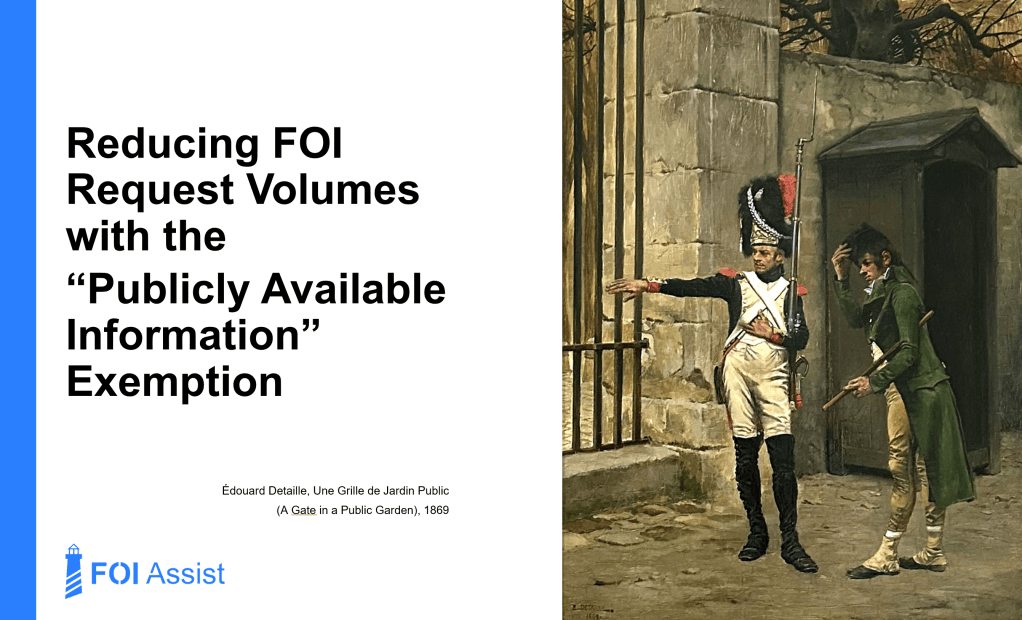
FOI Assist hosted the fifth seminar in the FOI Assist Seminar Series (2026) earlier today. Thank you to everyone who attended!
This seminar explored how Ontario’s public institutions can reduce the volume of Freedom of Information (FOI) requests they receive by setting up alternative systems for providing access to records.
In particular, we examined the “Publicly Available Information” exemption under section 22 of the Freedom of Information and Protection of Privacy Act (FIPPA) and section 15 of the Municipal Freedom of Information and Protection of Privacy Act (MFIPPA). These provisions allow institutions to refuse disclosure through the formal FOI process where the requested records are made available to the public through a regularized system of access.
The complete seminar slides are available below.
Not Every Request Needs to Be an FOI Request
The formal FOI process plays an essential role in ensuring public access to government information. However, that doesn’t mean every request for government records needs to be handled under FIPPA or MFIPPA.
In many circumstances, institutions can provide records more efficiently through alternative disclosure systems, sometimes referred to as routine requests, routine disclosure, or informal requests.
During the seminar, we explored several potential advantages of alternative disclosure systems, including:
- Simpler procedures: Avoiding unnecessary formal decision letters, time extensions, staged access plans, interim fee estimates, and other procedural requirements.
- Flexible timelines: Establishing service standards appropriate to particular types of records rather than applying the statutory FOI deadline to every request.
- Alternative fee structures: Charging more appropriate fees for the records being provided (when legally authorized to do so).
- Fewer opportunities for appeal: Avoiding the numerous procedural decisions and potential appeal points associated with the formal FOI process.
- Better distribution of work: Allowing other departments to handle records requests directly.
For frequently requested records, establishing a straightforward alternative disclosure process can benefit both institutions and the public.
The “Publicly Available Information” Exemption
One of the most interesting aspects of alternative disclosure is that institutions may, in certain circumstances, be entitled to refuse a formal FOI request and require the requestor to use an alternative access system instead.
The legal basis is the “Publicly Available Information” exemption under FIPPA section 22 and MFIPPA section 15.
These provisions allow institutions to refuse disclosure when the requested records have already been published, are expected to be published within 90 days, or are currently available to the public through a “regularized system of access.”
During the seminar, we examined what this means in practice and the circumstances in which institutions can rely on the exemption.
Important Limitations and Practical Considerations
Although alternative disclosure systems can significantly reduce the administrative burden associated with formal FOI processing, institutions must be mindful of several important limitations.
In particular:
- Records must genuinely be available to the public. A process restricted to property owners, involved individuals, or other qualified requestors may not support reliance on the publicly available information exemption.
- Privacy and confidentiality obligations still apply. Alternative disclosure does not eliminate the need to protect personal information, confidential third-party information, or other exempt information.
- Fees must be legally authorized. Institutions should confirm that they have the necessary authority, such as an applicable municipal by-law, before establishing alternative fee structures.
- The alternative system must provide meaningful access. Excessive fees or other barriers may prevent an institution from being able to rely on the exemption.
Where Should Institutions Start?
Institutions interested in reducing their FOI request volumes don’t need to overhaul their entire disclosure framework at once. A practical first step is to identify a particular category of records that regularly generates FOI requests and consider whether those records could instead be made available through a simpler process.
Depending on the records involved, this might mean publishing information online, establishing a dedicated request form or email address, or creating a fee-based routine disclosure service.
The important thing is to establish a clear, consistent, and accessible process that makes the records genuinely available to the public.
The FOI Assist software can also help your institution track and manage routine requests, with customizable letter templates and workflows, including support for application fees, processing fees, custom deadlines, time extensions, and more. Contact FOI Assist to book a demonstration.
Looking Ahead
Thank you again to everyone who attended Seminar #5.
If you have any questions or comments about the presentation, feel free to leave a comment below or contact me directly.
We have at least one more seminar planned for the FOI Assist Seminar Series (2026). Details and registration information will be announced through the FOI Assist Knowledge Base and emailed to subscribers.
To make sure you receive the next seminar announcement, subscribe to the FOI Assist Knowledge Base using the subscription box below.
I look forward to seeing you at the next seminar!


Leave a Reply